Uganda's school feeding guidance and national nutrition targets meet the daily reality of Busia and Namayingo, where a midday meal still depends on parents, employers and district budgets.
By David Okello..Busia and Namayingo Districts.6 min read
Last updated
Busia and Namayingo Districts. 11 March 2026.
MixedWorker Welfare & Livelihoods
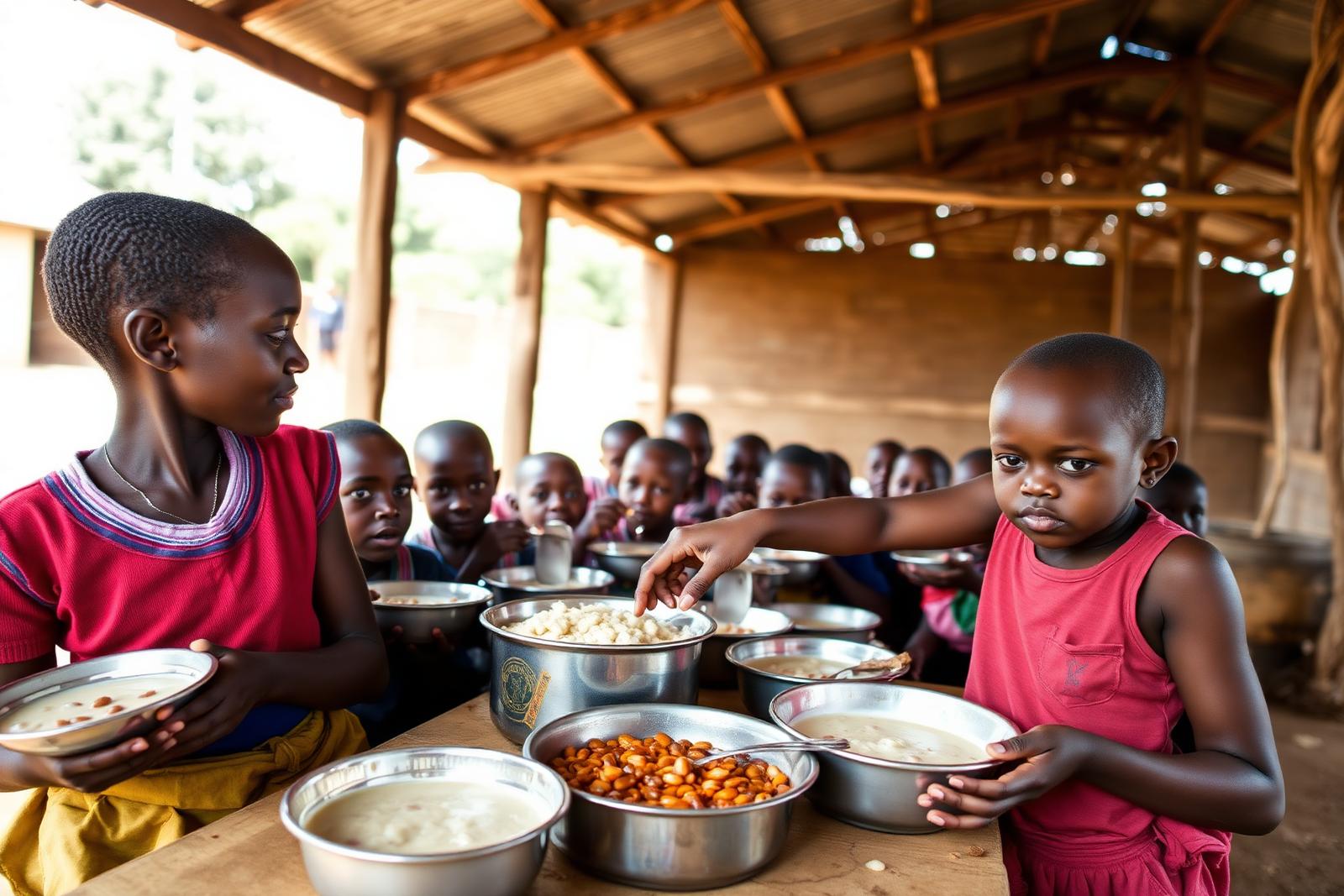
Uganda has no universal state-funded school meal. Government guidance places the midday meal with parents and communities, supported by districts and partners, so provision varies sharply from one sub-county to the next. In eastern Uganda that variation is visible by lunchtime: some classrooms empty, others do not.
What the national picture says
The Ministry of Health and its partners continue to treat chronic undernutrition as a development problem rather than a seasonal one. UNICEF and WHO country material sets out the same priorities that district nutrition officers repeat in interviews: dietary diversity, micronutrient intake and consistent feeding through the school day.
Head teachers in Busia describe the practical version of that policy. Where a parents' committee can hold a maize and beans contribution together, attendance in the afternoon holds. Where it collapses, so does the register.
The employer's part
Adult nutrition follows the same logic on a work site. A crew fed once during a shift is measurably steadier than one that is not, and where the food is bought locally the spend lands with the same households that send the children to school.
The district level detail on who is hired and who supplies those contracts is set out in our report on Busia local content, mining jobs and supplier registers where buying routed through registered local farmers is the clearest measure of benefit.
"
A meal is not welfare here. It is the difference between a full shift and a half one, and between a full class and a half one.
District nutrition officer, Busia
Field Dispatches
Get our weekly regional audits in your inbox
One email a week from the Kampala, Busia, Hoima and Jinja desks. What we checked, what we saw at the site, and what is still not adding up.
What is still missing
Measurement. Few schemes, public or private, publish intake data, and district records rarely separate a one-off donation from a standing weekly commitment. Until they do, nutrition claims in eastern Uganda remain difficult to audit from outside.
Why there is still no national feeding mandate
The Ministry of Education has cited fiscal constraints as the main reason Uganda has not adopted a universal state-funded school meal, a position consistent with the government's wider capitation funding model, which covers tuition-related costs but explicitly excludes feeding. Education economists note that several comparable East African countries have moved to centrally funded school feeding in the past decade, partly financed through World Bank or World Food Programme co-financing arrangements that Uganda has not yet taken up at national scale.
District nutrition officers argue that the absence of a national mandate has effectively privatised the policy response, producing exactly the patchwork LivingWellUganda has documented across Busia's sub-counties: parish committees, donor pilots and employer schemes filling a gap that, in their view, a modest per-pupil capitation top-up could close far more evenly.
"
We do not need a new ministry programme invented from scratch. We need the existing capitation line to include a meal.
District education planner, eastern Uganda
What analysts will be watching is whether the Ministry of Education's next budget framework paper includes any feeding budget at all. That single line would signal whether Uganda intends to move toward the co-financed feeding models neighbouring countries have already adopted.
Frequently asked
Frequently asked questions
Does Uganda have a national school feeding programme?
There is no universal state-funded school meal. Government guidance places responsibility for the midday meal with parents and communities, supported by districts, development partners and, in some areas, local employers.
Why does nutrition affect school attendance in eastern Uganda?
Head teachers report that afternoon attendance falls when no midday meal is available, because pupils travel home to eat and do not return.
What role do employers play in worker nutrition?
Some licensed operators in Busia run on-site meal schemes procured from local farmers, which supports both crew welfare and household income in the surrounding parishes.
Evidence & documents
Every claim above is checked against the records below. Open each one to see where it comes from.
David Okello covers Busia District from the ground: mine-site safety, local hiring and procurement, worker welfare, school and skills training provision, and the relationship between licensed operators and artisanal miners in the Green Belt.